There was a time in the United States when people believed that hard work, discipline, and patience would eventually produce a stable life. It was not a perfect promise, but it was a recognizable one. A dependable job, a modest home, a chance to save, and some hope for retirement once formed the backbone of the American social contract. That older equation has not vanished entirely, but it has fractured badly. Today, where you live often matters more than how hard you work, and that may be one of the most important economic truths in modern America.
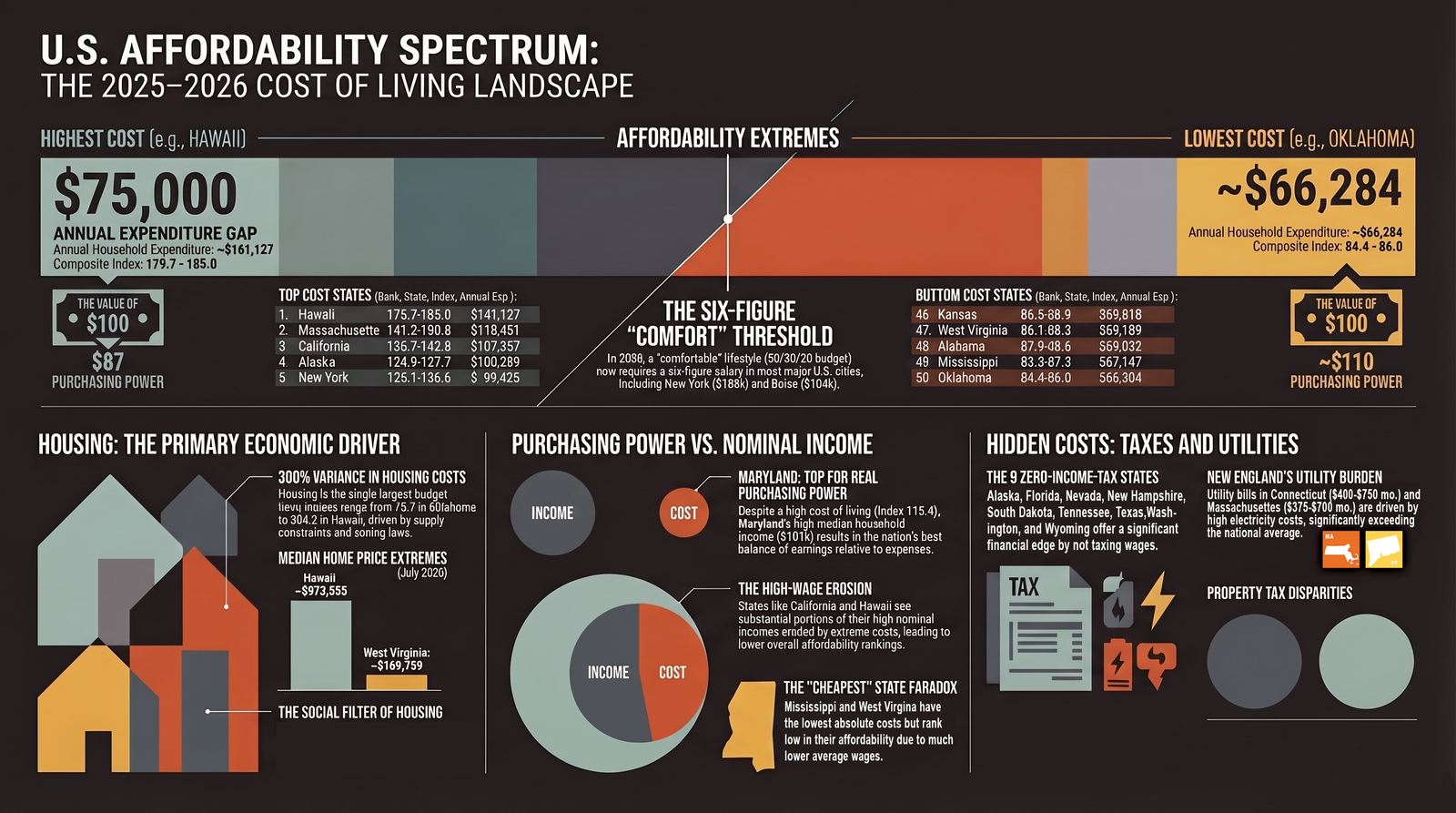
The latest affordability material gathered for this podcast section points to a nation that is no longer functioning as a single economic landscape. Instead, America now behaves like a collection of sharply divided regional systems, each with its own cost structure, wage reality, and degree of financial survivability. One of the clearest examples is the enormous spread between the most and least expensive states. The material identifies an annual gap of roughly $75,000 between high-cost and low-cost states, with Hawaii at the top and Oklahoma among the least expensive. In practical terms, that means two households with similar discipline and comparable life goals can experience radically different outcomes simply because they live in different places.
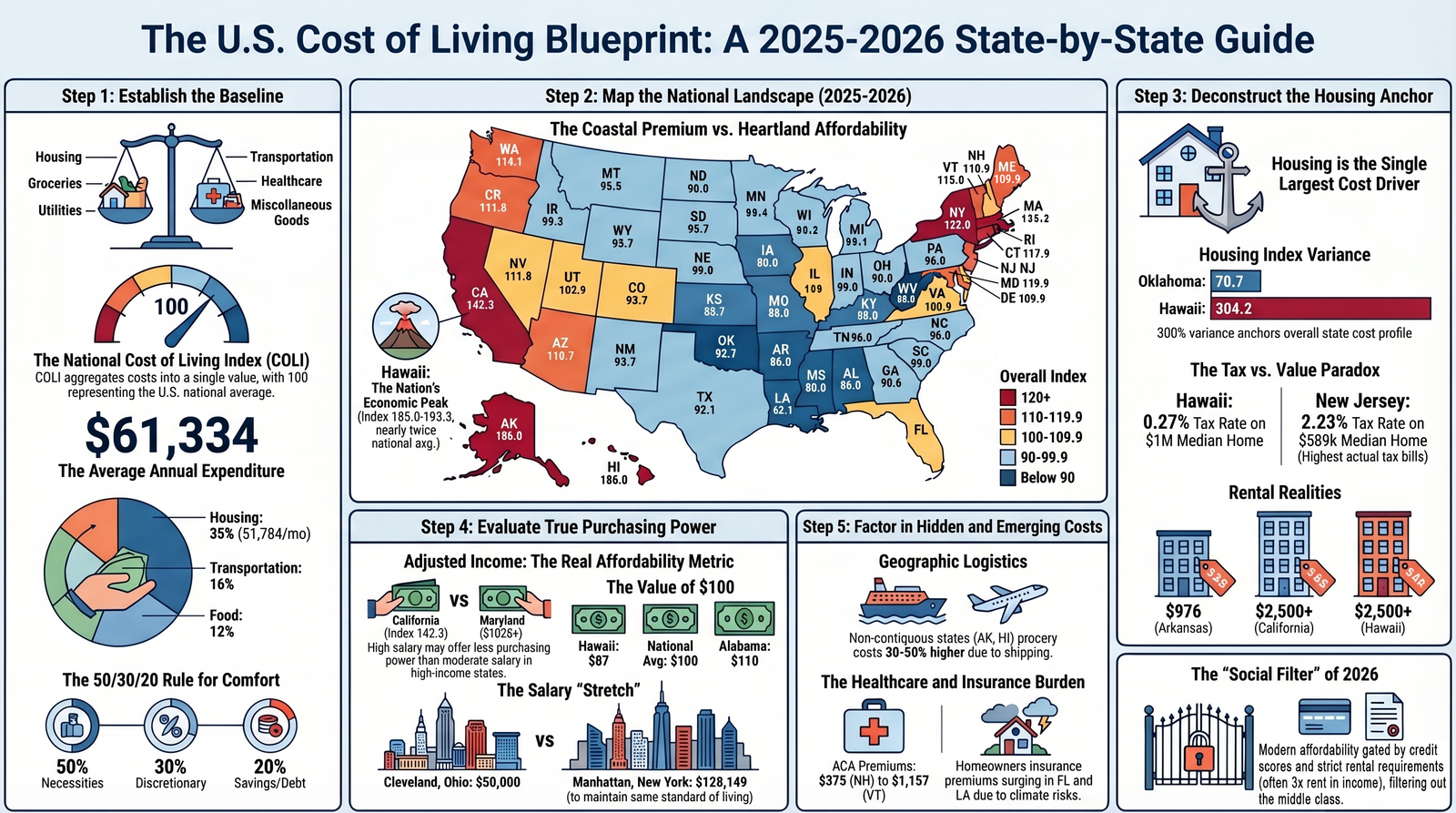
This is the heart of what might be called the price of place. Geography is no longer just scenery. It is no longer simply a matter of climate, culture, or preference. Geography has become a direct economic force that shapes whether a person can save money, buy a home, qualify for a rental, withstand a medical emergency, or retire without constant financial anxiety. The infographic material makes this point visually by showing a nation split between coastal premium zones and lower-cost interior regions, with housing serving as the major hinge in the entire equation. On the map and supporting charts, housing is presented not as one budget line among many, but as the dominant multiplier that destabilizes everything else.
That housing reality is especially striking. The affordability documents show that while categories like groceries, transportation, and utilities may swing significantly from state to state, housing is the category with the most punishing variation. One of the visual summaries highlights Oklahoma with a housing index around 70.7 and Hawaii at 304.2, showing a more than 300 percent variance in the category that anchors the entire cost structure. That kind of spread does not simply affect homebuyers. It ripples into rents, landlord screening, commute patterns, family formation, and whether people can remain in the communities they love.
For many Americans, this leads to a deeply frustrating experience. A person may earn more money than previous generations ever imagined, yet still feel permanently behind. One of the strongest themes in the material is the collapse of the old definition of a "good salary." The affordability presentation shows how an $85,000 salary, once widely associated with middle-class success, can now fail to cover basic existence in major high-cost markets after rent, food, transportation, utilities, and healthcare are accounted for. In that framework, higher nominal income can create the illusion of progress without delivering genuine security. The paycheck looks better on paper, but the lived experience feels like financial drift.
That leads directly to another major idea in this podcast series: nominal income is not the same thing as real purchasing power. This may be the single most important lens through which people need to rethink affordability in 2026. A six-figure salary in one state may buy less stability than a much lower salary in another. The documents repeatedly stress the importance of adjusted purchasing power, or what income is actually worth after local prices are taken into account. One example contrasts Maryland and Hawaii. Hawaii may post high incomes, but extreme costs dramatically erode what that money can really do. Maryland, by contrast, emerges as one of the strongest examples of a high-income state whose wage structure more effectively offsets local costs. In other words, some expensive states are still strategically livable because their earnings power remains strong, while others are simply punishing.
The reverse problem also appears in lower-cost states. A state can be inexpensive in absolute terms yet still fail the affordability test if local wages are too weak. This is the trap identified in the documents for places like Mississippi and West Virginia. Cheap does not automatically mean sustainable. If salaries are too low relative to even modest local costs, households can remain financially fragile despite living in markets that look inexpensive from the outside. That is a crucial distinction, because it challenges the simplistic advice people often hear: just move somewhere cheaper. The better question is not whether a place is cheap, but whether it offers a healthy balance between cost and earning power.
Housing also now operates as something more than a price tag. It has become, in many places, a social filter. That phrase fits the data well. The material describes a rental market where landlords increasingly require applicants to earn three times the monthly rent, carry strong credit, and present a nearly flawless risk profile. In that environment, even people with decent incomes can be screened out of stable housing. The issue is no longer simply whether you can pay. The issue is whether your entire financial profile satisfies an intensified gatekeeping system. The old idea that housing is a door you unlock through work and responsibility is giving way to a harsher reality in which housing functions like a checkpoint.
The same broad pattern appears in healthcare. The material portrays healthcare as a growing fixed cost of belonging to the system at all. Premiums, deductibles, co-pays, and the fear of major bills combine to create what is effectively a survival fee. The burden is not confined to people who are chronically ill. Even healthy families can find themselves paying thousands of dollars each year merely to remain insured and exposed to additional out-of-pocket expenses if something goes wrong. In that kind of environment, illness becomes not only a medical crisis but a financial one, and many households begin making care decisions based on cost anxiety rather than health needs.
One of the more revealing ideas in the material is the critique of so-called tax havens. States without income tax often market themselves as affordable refuges, but the documents argue that this can be a mirage. Florida, Texas, and New Hampshire may save residents money on one side of the ledger, but those savings are often offset by higher property taxes, insurance costs, or other recurring burdens. In Florida, insurance and broader cost pressures complicate the retirement fantasy. In Texas, property taxes can become the recovery mechanism for revenue. In New Jersey, meanwhile, the opposite extreme appears: high taxes layered on top of already substantial housing burdens. The lesson is clear. There is no shortcut in the modern cost-of-living equation. If a state does not collect its burden through income tax, it may simply collect it elsewhere.
This matters enormously for retirees as well as workers. Retirement used to be imagined as a stage of life when a fixed income could buy peace, modest comfort, and a little freedom. But retirement intensifies geographic inequality because income stops flexing while local costs keep climbing. The presentation on retirement realities highlights a divide between "quiet winners" and "unviable extremes." In that framework, states with predictable housing, manageable taxes, and functional healthcare systems become much more attractive than glamorous but punishing high-cost states. This is one reason why retirement migration has become less about sunshine and more about survivability. For many people, scenic appeal no longer outweighs the arithmetic.
So what does all of this mean for a project like Songs Across America? It means that the American landscape is not only cultural and scenic. It is also economic, structural, and deeply uneven. Songs can capture the emotional truth of a place, but podcasts give us room to explore the lived mechanics underneath that truth. A state is not just its mountains, rivers, music, or city skyline. It is also rent pressure, healthcare access, grocery logistics, wage levels, and whether ordinary people can imagine a future there. To understand modern America honestly, we have to talk about both the beauty of place and the burden of place.
That is why this podcast section matters. It allows us to examine the changing architecture of American life through a broader lens. We can ask harder questions. What does it mean when a strong salary no longer produces security? What happens when homeownership turns into a distant privilege instead of a reachable goal? Why do some lower-cost states still leave workers trapped? Why are more Americans discovering that the most important financial decision they may ever make is not what job they take, but where they live? Those are not abstract policy questions. They are daily questions, family questions, and increasingly, identity questions.
In the end, the affordability story of America in 2025 and 2026 is not merely about inflation or personal budgeting. It is about the restructuring of possibility itself. The old promise that effort alone would carry people forward is being tested by a new geographic math. In some places, the numbers still allow breathing room. In others, they impose a permanent treadmill. Understanding that divide is essential not only for workers, retirees, and families, but for anyone trying to understand the nation as it really is. And for a website devoted to the spirit, story, and geography of America, that conversation belongs here.

 Back to American Podcasts